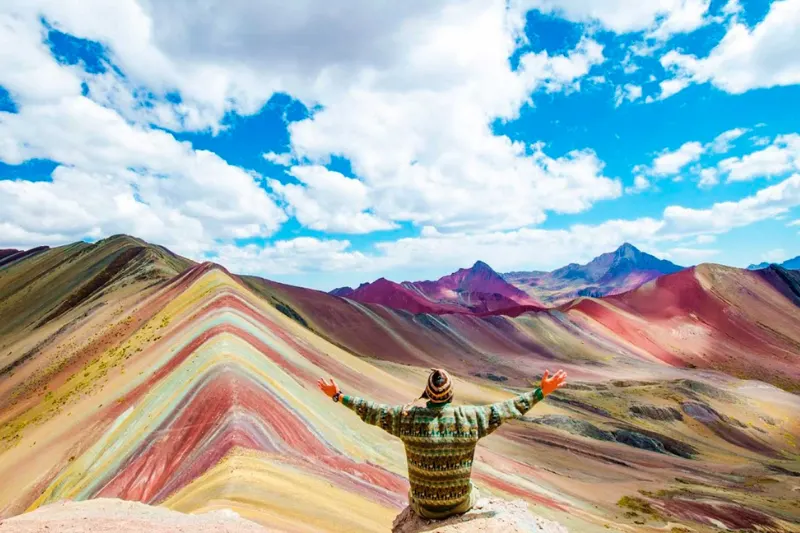
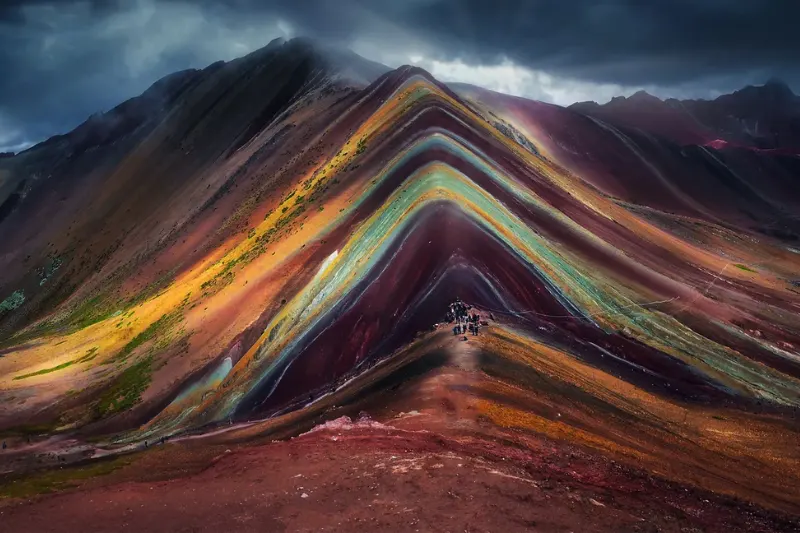
Until roughly 2013 this mountain did not exist visually. Not because it was not there. Because glacier ice covered it completely. The stripes, the colors, the entire visual spectacle that now fills social media feeds was sealed under high-altitude ice for millennia. Global warming melted that ice. Permafrost beneath it thawed around 2015.
Why is vinicunca colorful is a question with a specific scientific answer that has nothing to do with the mountain being unusual. It is colorful because ancient geology, chemical weathering, and tectonic violence all happened in the same place across millions of years. The ice just hid the result until recently.
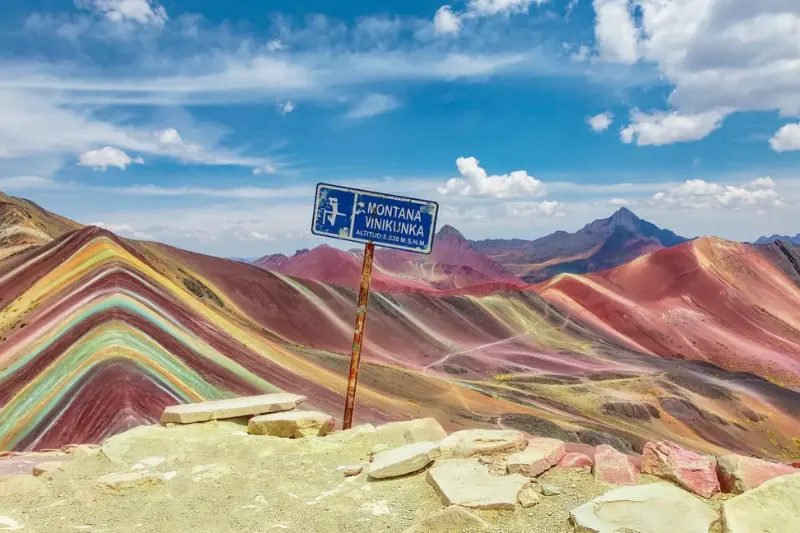
Vinicunca sits in the Cusco region at 5,200 meters above sea level. The name comes from Quechua and translates roughly to multicolored mountain. Local Quechua communities knew the terrain long before the glacier retreated and the colors became visible to outside visitors.

Before it was a mountain it was a basin. Flat. Empty. Over millions of years different materials accumulated in layers depending on what the environment was doing at the time. Shallow inland seas deposited one type of sediment. Desert conditions deposited another. Ancient river floodplains left a third. Each environmental phase produced a distinct material layer pressed flat and locked in sequence beneath the ones that came after it.
Fast-moving rivers carried heavy sand grains that hardened into sandstone bands. Slower water and stagnant lakes left fine mud that compressed into shale. The alternating rhythm of those deposits, coarse then fine then coarse again, built the structural foundation of what vinicunca geology would eventually expose to the surface.
Tour vinicunca rainbow mountain operators depart Cusco between 3 and 4 AM specifically because the drive to the Cusipata district trailhead takes several hours and morning light at the summit produces the best color visibility. That early departure is not optional. It is dictated by the distance and the geology.
Vinicunca colors did not come from the sediment itself. The structure came from the sediment. The color came from something that happened to those layers afterward, once they were exposed to the atmosphere. The sediment built the canvas. Chemistry did the painting.
Glaciers melted. Raw stone hit rain and oxygen for the first time. Chemical weathering began. The process is the same one that turns a metal bicycle red-brown after enough time outside. Oxidation. The mineral compounds in each sedimentary layer reacted with the atmosphere at different rates depending on their specific composition. The result is what makes rainbow mountain readable as a color chart from a distance.
Each color maps to a specific mineral reaction:
Why is vinicunca colorful in stripes rather than blended patches? Because each ancient sedimentary band contained a different mineral mix and each mix aged at a different rate. The stripes are not painted on. They are the natural result of different materials responding to the same atmospheric exposure over thousands of years.
Mountain hues this vivid require specific viewing conditions. Moisture deepens the reds and greens by acting as a natural varnish on the mineral surface. Dry conditions flatten the colors. Midday sun washes out the contrast. Early morning light in the dry season, May through September, consistently produces the most saturated visual result.

Flat sedimentary layers sitting underground do not produce a visible mountain. Something has to push them up. In this case that force was the Nazca tectonic plate sliding beneath the South American plate in a process called subduction. The collision is slow by human timescales. The force it generates is not.
Think of pushing two edges of a thick rug toward each other on a hard floor. The center has nowhere to go except up. That upward pressure drove the formation of the entire Andes range. During that process the flat colored sedimentary layers that had accumulated underground for millions of years were compressed, folded, and tilted onto their sides. Vinicunca geology is the result of that tilting. The horizontal layers became vertical stripes. What would have been invisible underground cross-sections became the face of a mountain visible from kilometers away.
Why is vinicunca colorful in vertical bands rather than horizontal ones? That tectonic tilting is the answer. The layers were deposited horizontally. The collision stood them up. Standing in front of the mountain now means standing in front of a cross-section of Earth’s crust that was pushed into the sky by continental forces and then uncovered by melting ice.
Cusipata is the small town closest to the trailhead and the last point of road access before the trail begins. Most tour vehicles stop here briefly before the final approach. Local vendors at Cusipata sell water, snacks, and basic cold weather gear for visitors who arrive underprepared for the summit conditions.
Photographs of Vinicunca circulating online are often taken under specific conditions that do not represent every visit. The mineral surface behaves like a wet river rock. Dry, it looks dull. Wet or in the right light, the oxidized compounds saturate visually. Ambient moisture deepens the reds and greens. Low-angle morning light catches the crystal surfaces differently than midday overhead light.
Dry season, May through September. Morning arrival. Those two factors produce the highest probability of the color intensity that makes the destination worth the altitude effort.
Palcoyo vs vinicunca is a comparison worth making before committing to either. Same geological origin, different physical demands and different crowd levels:
The choice depends on physical capacity and crowd tolerance. The geology producing the colors is comparable. The experience on the ground is not.

17,060 feet. The air at the summit holds roughly half the oxygen available at sea level. Altitude sickness is not a possibility at this elevation. It is the expected physiological response for anyone who has not acclimatized. Symptoms range from headache and nausea to dizziness and shortness of breath at rest. Two days in Cusco before the attempt is the standard buffer. One day is usually not enough for most visitors coming from sea level.
Coca tea is available at vendor stops along the trail and at the Cusipata area before the ascent begins. Drinking it before and during the climb takes the edge off early altitude symptoms for most people without pharmaceutical side effects. The mild stimulant effect helps the body manage fatigue at elevation in a way that hot water alone does not.
Preparation before the trek:
Why is vinicunca colorful in a way that is also fragile? The stripes are a mineral crust on the surface of the rock. Not deep pigmentation. Not paint. A crust. Heavy boots off the marked trail crush it permanently. That damage does not recover. The trail markers exist for geological reasons as much as safety ones.
Why is vinicunca colorful comes down to four things happening in the same place: millions of years of layered sediment deposition, chemical weathering of iron and clay minerals, tectonic tilting that stood the layers vertical, and glacial retreat that uncovered the surface within living memory.
None of that is accidental. None of it is stable indefinitely. The mineral crust is fragile. The glacier that hid it is gone. The permafrost that held the structure is degrading. The window for seeing vinicunca colors in their current state is real and finite.
Marked trails. Acclimatization. Dry season timing. Certified local guides. Those are the practical commitments that extend both the visitor experience and the geological feature itself.